This will be the last post on the blog. As of February 1, I am no longer working at the IISS. I can say with confidence that the dialogue was successful in bringing together a diverse group of experts to discuss how climate change will affect a broad range of security threats. We held workshops on water, food, and energy security. We held larger conferences to bring the debate outside the experts, in both Washington and Brussels.
We delivered our report (PDF) to the European Commission at the end of January. With the completion of the report, my time at the IISS has come to an end, and I have moved on. If you are looking for updates on me, take a jump over to my personal website at www.andrew-holland.com. I will also continue my blogging at www.revolutionarytransitions.blogspot.com. I will continue to look at how climate change affects security, but I will also write about the broader changes that the earth and human society are undergoing. I hope that you will update your RSS feeds and your bookmarks.
Finally, if you are looking for the most up-to-date analysis of global affairs from the IISS, I would direct you to the IISS voices blog, which should be your first stop for any global security issue.
Thanks go out to all who participated in our events; it would not have been a success without you. Thanks also to everyone who followed this blog from its inception to its closure. I really believe that blogging is the best way to reach a large and connected audience around the world. Thank you.
Friday, February 11, 2011

Friday, February 4, 2011
Summary of the Launch Event in US

If you are going to be in London on Monday, I would encourage you to sign-up to attend the London event of this at our headquarters.
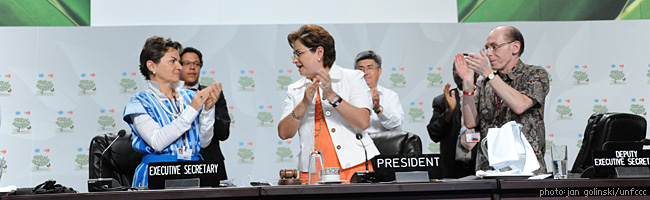
The Washington event featured your humble blogger, Andrew Holland, in my capacity as the Research Associate and Programme Manager for the IISS Transatlantic Dialogue on Climate Change and Security (right, in the picture). I spoke about the main findings and recommendations that were presented in the report. Esther McClure, the Strategy Action Officer for Arctic, Energy and Environmental Policy in the Office of the Secretary of Defence - Policy responded to the report and gave an overview of what how the Pentagon is looking at climate change (left, in the picture). She was speaking in her capacity as an expert on the issue, and was not speaking for the US government; her remarks were off-the-record, so all I can say is that she was very good, and presented some interesting ideas. The event was moderated by Günter Hörmandinger, the First Counselor for Environment of the Delegation of the European Union to the United States of America (center, in the picture).`Although you can't read any of Esther's comments, after the jump, I am happy to provide a summary of what I said at the event.
Friday, January 21, 2011
Event Advisory: “The Results of the IISS Transatlantic Dialogue on Climate Change and Security”
Next week, on Wednesday, I will be presenting the results of the IISS Transatlantic Dialogue on Climate Change and Security at the IISS's US office here in Washington. Esther McClure, a Strategy Action Officer for Energy and Environmental Policy at the Pentagon. The discussion will be moderated by Günter Hörmandinger, the Coundelor for Environment from the Embassy of the European Union.
The event will begin at 4:45 pm on Wednesday, January 26. It should be an interesting discussion that will hopefully highlight some of the areas of differences and for cooperation in the approach of the US and EU to climate and security policy.
Here's a sneak peak:
Climate change is at the heart of both national and collective security. The earth is unequivocally warming, and no matter what action is taken to reduce global greenhouse gas emissions, that warming is very likely to continue for at least the next 30-40 years. This discussion will focus on the role security planners have in preparing for a warmer climate, so that the impacts of climate change – like sea level rise, changes in water resources, or food shortages – do not fuel conflict.
On another note, this will be my swan-song with the IISS. As this program comes to an end, my time at the IISS will also come to an end.
There is still room available. To join us at the event, please RSVP to events-washington@iiss.org. I am looking forward to a good discussion with our panelists and our participants.
Next week, I'll post details of what will happen to this blog after I've left the IISS. I will also post the link to the report, when we put that up on the IISS' website.
Tuesday, December 14, 2010
Climate Agreement in Cancun: Important Progress, but Difficult Questions Remain Unanswered
In the early hours of Saturday morning in the Mexican tropical resort of Cancun, international climate negotiators from the 193 countries and observer states came to agreement on what will now be know as the 'Cancun Agreements'. After the very public perceived failure of the Copenhagen summit last year in Denmark, it was very important that this meeting ended successfully. I wrote last week that "A failure to come to any agreement in Cancun would probably spell the end of the UN as a negotiating forum for climate change."
The agreement text came out of two separate negotiating forums, the "Ad Hoc Working Group on Further Commitments for Annex I Parties under the Kyoto Protocol" and the "Ad Hoc Working Group on long-term Cooperative Action under the Convention". The formal agreements, to be found here and here, respectively. There are two negotiating tracks within the UNFCCC because the parties to the Kyoto Protocol do not include all of the countries that are signatories to the UNFCCC, most notably the United States.
What to do with the Kyoto Protocol, expiring in 2012, was the source of the most contention during the summit. I worried last week that the Cancun Summit could fail under the divide between developed and developing countries, enshrined as a part of the Kyoto Protocol. Kyoto is fatally flawed because it asks everything from developed countries, while asking nothing from developing countries - which include many of the world's largest emitters, like China (#1), India (#4), Brazil, and Indonesia. It was further weakened because the United States, bowing to political and economic reality, chose first not to ratify it, then to withdraw from it. The Cancun Summit ended in success simply because it decided to 'punt' on the issue of whether to continue Kyoto after it expires in 2012. Next year's summit in Durbin, South Africa will be the last conference before Kyoto's expiration, so this question will have to be addressed by then.
Although the Cancun Agreement dodged the question of Kyoto, there are some significant achievements of note. It formally commits the parties of the UNFCCC to ensuring that climate change does note exceed 2 degrees of warming over this century. On mitigation (agreements to reduce emissions), the Cancun agreement codifies the voluntary mitigation targets agreed to by signatories of the Copenhagen Accord. This is a huge milestone, because it is the first time that all major economies have pledged explicit actions in a UNFCCC document since its creation in 1992. It also made significant steps on a climate financing mechanism for adaptation and mitigation by developing countries. It delegates to the World Bank the responsibility for creating a "Green Climate Fund" that would mobilize the pledged funding of $100 billion a year in public and private financing promised by 2020.
In January 2010, I wrote in an IISS Strategic Comment that "the success of the Copenhagen Accord had yet to be seen". The Cancun agreement essentially adopts the Copenhagen Accord, including the emission mitigation targets voluntarily submitted by approximately 80 countries and the measuring, reporting, and verification compromise agreements - largely negotiated between the United States and China. The Cancun Agreements successfully brought the Copenhagen Accord into the UNFCCC negotiating process. Therefor, upon further reflection, it seems that Copenhagen, too, was a bit of a success, had it been judged against any standard that wasn't so ambitious to say that Copenhagen as the "Summit to save the planet".
At Cancun, negotiators yet again failed to save the planet - the mitigation targets agreed to could bring up to 3 or 4 degrees of warming over this century - but they did succeed in creating much of the global architecture that one day could help to save the planet.
Friday, December 10, 2010
Cancun Climate Summit Troubled by Copenhagen's Divisions
For the past two weeks, government officials, climate campaigners, and the traveling circus that follows international negotiations have descended on the tropical resort island of Cancun on Mexico’s Caribbean Coast.
 The Cancun summit was not supposed to come up with a formal global deal on climate emissions. Instead, it was to make incremental progress on agreements for financing of adaptation and mitigation in developing countries, and agreement on “Reducing Emissions from Deforestation and Degradation” (REDD). There is also continued hope that the two largest emitting countries, China and the United States, can come to agreement on how to monitor, report, and verify actions on emissions. Action on this is important to the United States, so that they know that any agreements negotiated will be fulfilled. Likewise, it is important to China to resist overly intrusive measures that would compromise their national sovereignty. Hope was raised on agreement on this issue in remarks made by China Huang Huikang, the Chinese Foreign Ministry's envoy for climate change talks:
 "We can create a resolution and that resolution can be binding on China. Under the (U.N. Climate) Convention, we can even have a legally binding decision. We can discuss the specific form. We can make our efforts a part of international efforts."
Ultimately, the goal of Cancun was to act as a bridge to the 2011 summit in South Africa, in hopes of negotiating a formal settlement there.
However, there is an issue that has arisen as the most important and contentious – and threatens to bring down the talks: whether countries will agree to an extension of the Kyoto Protocol after its planned expiration date in 2012. Many negotiators, including the United States, thought that the Kyoto Protocol – signed by President Clinton in 1997, never ratified by the Senate, and formally withdrawn from in 2001 by President Bush – had been finally killed by the Copenhagen Accord last year.
The division over Kyoto boils down to the same developed/developing country divide that plagued the Copenhagen Summit last year. By and large, developing countries want to extend Kyoto, and developed countries want to switch negotiations to a treaty that would look like the Copenhagen Accord. The foundation of this dispute is that the Kyoto Protocol was negotiated and agreed under the principle of “common but differentiated responsibility”. What that means in practice is that developed countries are responsible for making verifiable emissions reductions, while nothing is asked of developing countries. The United States and EU argue that it is unfair to ask developed countries to reduce their emissions, while large developing countries, including China or India – the 1st and 4th largest emitters in the world, respectively – are not asked to reduce their emissions. Not only is this inequitable, it is inefficient – because businesses could simply more their production from a place like Europe – where carbon emissions are limited by law, and therefore cost money – to China, where carbon pollution is not limited. In the terms of the climate change debate, this is called ‘Carbon Leakage’ and it implies that global emissions (the only thing that matters for climate change) could actually go up by limiting emissions in one area, but not in another. So far, only Japan and Russia have formally come out against extending Kyoto, but Canada and other countries are also likely to oppose an extension.
However, with some developing countries, support for Kyoto has become a symbol of anti-western solidarity. Most developing countries, however, are in favor of extending the Protocol, with some Latin American countries, notably Bolivia and Venezuela, saying they will not support any agreement that comes out of Cancun unless it continues the principles of the Kyoto Protocol. This threat is credible because Venezuela, Bolivia, and Sudan blocked formal ratification of the Copenhagen Accord last year over similar concerns.
Another factor in the debate about the Kyoto Protocol is that the United States is not a signatory to the Protocol, and an extension of it would mean that the US is not involved. The American negotiators are insisting that agreement that comes out of Cancun moves beyond Kyoto and recognizes the legitimacy of the Copenhagen Accord and the 2020 emission targets which both developed and developing countries made when they signed onto it.
A failure to come to any agreement in Cancun would probably spell the end of the UN as a negotiating forum for climate change. Last year’s Copenhagen summit left a bitter taste with many participants, because of the inability to negotiate among such a large and unwieldy body. Already, forums like the G-20 and the Major Economies Meetings on Climate Change and Energy Security are beginning to supplant the UN.
Interesting Links:
The UNFCCC is very transparent in the negotiations. Anyone wishing to follow today's negotiations can watch it here. The Cancun Summit's home page is here.
The IISD's reporting service has done an excellent job summarizing each day's conference. You can find it here.
Finally, the newspaper doing the best job in their coverage of this is the Guardian, here.
Wednesday, December 8, 2010
The Melt - Asia Society
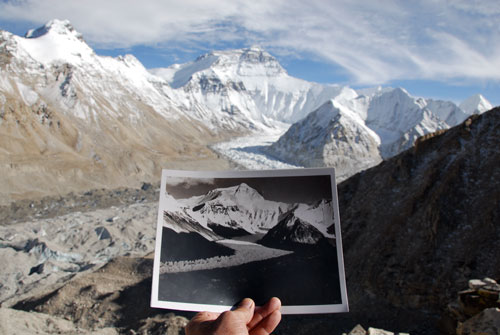
The Asia Society's "China Green" project has a new video out on their website called "The Melt" that gives a very quick, but important overview on how the glaciers in the Himalayas are changing, and the impacts that are being felt by the people who live in that area.
The video is clearly of very high production quality, and relies not only on interviews of western researchers, as sometimes happen in these sort of productions, but they also sent a film crew to Tibet to chronicle the changes in glaciers.
I've written about this on our blog several times. Its important to remember that, although the IPCC report was wrong to say that all the glaciers may be gone by 2035, they are melting - at an increasing pace.
Some quick quotes from the video: "It's mostly about water" "If this keeps going, people and animals will no longer be able to get enough water". The focus on water as the first, and most important impact of climate change on human society tracks exactly with the findings of the IISS.
Videos and projects like this are extremely important, because they are not only aimed at western audiences. By traveling over to China and interviewing people in Tibet, videos like this can raise awareness within China too about the impacts of climate change. As the two largest emitters of carbon, the US and China are the key players in acting to reduce their emissions - and nations act only when it is in their interest to act. This video makes it clear that China, and Tibet, are already paying the costs for climate change.
I tried to have the video embedded here, but they have not released the code. Head over to their website, and watch the whole 10 minute video. It is well worth your time.
The video is clearly of very high production quality, and relies not only on interviews of western researchers, as sometimes happen in these sort of productions, but they also sent a film crew to Tibet to chronicle the changes in glaciers.
 |
| Source: Asia Society |
Some quick quotes from the video: "It's mostly about water" "If this keeps going, people and animals will no longer be able to get enough water". The focus on water as the first, and most important impact of climate change on human society tracks exactly with the findings of the IISS.
Videos and projects like this are extremely important, because they are not only aimed at western audiences. By traveling over to China and interviewing people in Tibet, videos like this can raise awareness within China too about the impacts of climate change. As the two largest emitters of carbon, the US and China are the key players in acting to reduce their emissions - and nations act only when it is in their interest to act. This video makes it clear that China, and Tibet, are already paying the costs for climate change.
I tried to have the video embedded here, but they have not released the code. Head over to their website, and watch the whole 10 minute video. It is well worth your time.
Friday, November 19, 2010
Europe Can Teach America about Energy Security and Climate Policy
Yesterday, Forbes.com published a column by Larry Bell, “Disarmament in America’s Energy Security Battles”. I thought it was extraordinary, even by the low standards of opinion journalism, in its blatant disregard for the facts. So, I wrote to Forbe's editors, in order to correct the record. I've copied the letter below.
I am writing in response to Larry Bell’s November 18 column, “Disarmament in America’s Energy Security Battles” printed on Forbes.com. This column is notable for its lack of facts and its assertions against renewable energy that simply do not have a basis in reality. Mr Bell uses hyperbolic language and assertions that are simply not backed-up by the facts.As a favor, then, to Forbes’ editors and readers, I will attempt to put some real facts behind his statements, then you can determine whether his assertions are correct, or just hot air. As the author of “Learning from Europe on Climate Change” in the December 2009 issue of Survival, I am well-placed to offer informative, fact-based analysis of energy security and climate policies. I would appreciate it if you would print my response in full.
 |
| An unfairly maligned Spanish wind farm |
First, Mr Bell asserts that the EU is facing “costly, yet unsuccessful, CO2 emission reduction efforts.” In fact, the opposite is true – the EU has been successful in reducing its emissions, and at low cost. Last month, the European Commission released a report stating that, by 2012 (the date for compliance with the Kyoto Protocol) the emissions of the EU-15 (the 15 Western European countries) will be 10.4% below 1990 levels, and the emissions of the EU-12 (the 12 former East Bloc countries) will be 36.8% below 1990 levels. This means that the EU as a whole will reduce its emissions 17.3% below 1990 levels. Alone among major developed economies, the EU will meet the emission reduction commitments it made when it signed the Kyoto Protocol. In Europe, it is true, the cost of energy – both electricity and gasoline – is generally higher (rates vary greatly throughout the EU), but that is the result of long-standing government policies that encourage energy security, not a recent increases from climate policies. In France, for instance, the cost per KWh of electricity is about 19.25¢, while in the USA, it is about 10.45¢.
Mr Bell then goes on a rant against the wind industry. It is true that wind energy requires high up front infrastructure costs, but he does not acknowledge that once they are running, there are no fuel costs – which can fluctuate widely – as there are with traditional electricity power plants. He then cites a report from Spain, repeatedly pushed by the right-wing Heritage Foundation, that has been widely debunked as based upon flawed analysis and untrue foundations. For instance, the report estimates that Spain’s renewable program created only 50,000 jobs, when official estimates are 188,000. The argument they make is that supporting renewable energy destroys jobs by causing the loss of 2.2 jobs for every 1 created. It is based on flawed analysis, and it just goes to show that you can always find an economist to support your view. It doesn’t make them right, though.
Mr Bell then states that “high wind power premiums” get passed onto customers, while talking about wind farms in Texas. What he doesn’t mention is that in his home state of Texas, the state with most installed wind power – about 8 gigawatts – the Public Utility Commission said “Wind generation has had the impact of reducing wholesale and retail prices of electricity.”
Monday, November 8, 2010
US Climate Policy with a Republican House
Below is a blog post from IISS intern, Marie Steinrucke, with a good analysis of how climate policy affected the elections, and what that means for policy going forward. I’ve presented it mostly unchanged. I’m hopeful that there’s space for agreement and compromise on climate policy in the next Congress, but certainly there is some reason for pessimism.

Since the Republicans regained control of the house on November 2nd, newspapers and blogs have been debating to what extent the GOP victory will affect possible climate change legislation. Opinions are sharply divided between those who believe that the election outcome will be detrimental for climate change action and those who say that the election was only marginally about the issue.
In analysing the possible effects of the GOP wins it is useful to look at how voting on the Waxman-Markey climate bill affected candidates’ re-election. In his blog for the Council on Foreign Relations, Michael Levi asserts that the issue of cap-and-trade mattered only in individual races, but did little for the overall victory of the Republicans in the house. Furthermore, when the bill did matter in individual races, it tended to be in those battles where the Democratic candidate was already in deep trouble. Samuelson and Bravender of Politico argue on the contrary, saying that many incumbent Democrats, particularly from rural, suburban and industrial districts lost their seats in part due to their vote on the climate bill.
The big question remains: how does all this affect President Obama’s big plans for energy reform? The truth may be that Obama has already accepted some degree of defeat on the energy front and realizes that sweeping reforms in the energy sector fall in the category of wishful thinking in the current political climate. The New York Times recently quoted him saying: “Cap and trade was just one way of skinning the cat; it is not the only way.” He was open to introduce smaller policy ‘bites’ in order to attract Republicans. Obama probably knew that any cap-and-trade policy was impossible, at least for now, when it failed to pass in the Senate this summer. The question will be whether Republican members of Congress will accept even small concessions on the energy front or whether they will categorically oppose reform suggestions in a harsh economic climate. President Obama is facing a new Congress in which many newly-elected members do not believe in the concept of global warming caused by humans and the new speaker of the house, John Boehner (R-OH) has labelled energy reform solutions as “job-killing energy taxes.”
Proponents of climate change action do have one victory to flaunt after the November 2nd slaughter. In California, voters vehemently opposed proposition 23, a ballot initiative that would have reversed state-wide clean-energy requirements. In its reporting on the issue, the Christian Science Monitor called this rejection a sign that the election was about housing and jobs, not about energy issues.
Although one may argue about the importance of energy reform legislation in the 2010 midterm election, it remains to be seen how the shift towards a Republican controlled house will affect President Obama’s energy agenda. Will he be able to frame the debate in a way acceptable to Republicans or will they form a wall of resistance? The change certainly means that he will have to unite his own party on energy issues, a difficult task in itself. One can hope that the Obama administration will see its party’s losses as an incentive to re-frame the energy debate to make it more appealing to conservative leaders.
Friday, November 5, 2010
Climate Wars: Not if, but When
Today, I am republishing a blog post from Jeff Mazo, the IISS' Research Fellow for Environmental Security and Science Policy. He posted it to the IISS 'Voices' blog about a presentation given in London by Gwynne Dyer about his new book "Climate Wars". I've met Gwynne several times, and his analysis is always very interesting, even if the prognosis does tend to the pessimistic, as Jeff says below. The difference between Jeff and Gwynne's prognosis is not only a difference in magnitude, but also the difference between how an analyst and a reporter look at these problems. Why not buy both of their books and see for yourself?



Imagine this: sometime in the next 10–15 years, a tide of refugees heading north from Mexico prompts the US military to seal the border. With an increasing proportion of the US population of Hispanic origin, negative publicity from the 24-hour news cycle and online media such as YouTube leads to 'the greatest social division since the Civil War'. This is just one of the dire scenarios that might arise from climate change set out by journalist and author Gwynne Dyer at a discussion meeting at the IISS in London on 4 November.
His remarks, based on his book Climate Wars, painted a bleak picture of a future where water shortages and crop failures lead to mass migration, state failure – 'Somalia × 20' in Africa and the Middle East – and wars between countries that share river systems already stretched to the breaking point.
If Iraq had a 'real army', Dyer said, it would already be at war with Turkey over the latter's dams on the headwaters of the Euphrates. In South Asia, we can look forward to 20 years of summer flooding followed by excessively dry summers in the Indus watershed as the Himalayan glaciers disappear. War – possibly nuclear – over water was likely between India and Pakistan within the next 25 years.
Dyer's scenarios are far more pessimistic than anything I discuss in my own Climate Conflict, published in the IISS Adelphi series earlier this year. This is principally because he is looking at worst cases in terms of projections of emissions and their climate impacts, whereas I deliberately chose to take a more conservative approach. I considered a world where, in the next two or three decades, the climate impacts of global warming are of a magnitude similar to the normal background variation.
I have no doubt that unmitigated climate change will eventually lead to the types of consequences, if not the exact scenarios, Dyer foresees. The question is how soon we can expect them – in 20 years, in 50 years, in 100 years. The scientific uncertainty is quite high and it would be rash to take either version as gospel.
His remarks, based on his book Climate Wars, painted a bleak picture of a future where water shortages and crop failures lead to mass migration, state failure – 'Somalia × 20' in Africa and the Middle East – and wars between countries that share river systems already stretched to the breaking point.
If Iraq had a 'real army', Dyer said, it would already be at war with Turkey over the latter's dams on the headwaters of the Euphrates. In South Asia, we can look forward to 20 years of summer flooding followed by excessively dry summers in the Indus watershed as the Himalayan glaciers disappear. War – possibly nuclear – over water was likely between India and Pakistan within the next 25 years.
Dyer's scenarios are far more pessimistic than anything I discuss in my own Climate Conflict, published in the IISS Adelphi series earlier this year. This is principally because he is looking at worst cases in terms of projections of emissions and their climate impacts, whereas I deliberately chose to take a more conservative approach. I considered a world where, in the next two or three decades, the climate impacts of global warming are of a magnitude similar to the normal background variation.
I have no doubt that unmitigated climate change will eventually lead to the types of consequences, if not the exact scenarios, Dyer foresees. The question is how soon we can expect them – in 20 years, in 50 years, in 100 years. The scientific uncertainty is quite high and it would be rash to take either version as gospel.
Tuesday, October 19, 2010
The Nuclear Energy Debate in Germany and the US
 |
| Three Mile Island (Copyright National Geographic) |
In Europe and the United States recent developments have once again sparked the nuclear energy debate. The results may be counter-intuitive to many people who have followed the discourse in recent years. The German public has been highly critical of the country’s nuclear program ever since its inception in the 1970s, but those who hoped Germany’s nuclear age was coming to an end recently experienced a disappointment when Chancellor Merkel passed legislation in the German Bundestag to extend nuclear plant lifespans by up to 14 years. Ironically, both proponents and opponents of the lifespan extension argue that their stance is necessary to build up renewable energy capacities in years to come. The right-wing coalition supporting the extension says that nuclear power is needed to support Germany’s transition to renewable energy sources, while the left-wing fears that keeping the reactors on the grid longer will halt innovation in the field of renewable energy.
 |
| Germans Protest Nuclear Power (Copyright AP) |
In the United States, popular support for nuclear power has increased in recent years and commentators have predicted a ‘nuclear renaissance.’ Yet the failure of one company’s proposal to build a new plant on Chesapeake Bay indicates the difficulties currently faced by the industry. The Economist reports: “On October 8th Constellation Energy, a power company, gave up trying to persuade the government to reduce its proposed fee for a loan guarantee for a planned nuclear plant on Chesapeake Bay.” In an October 10th article by the New York Times the author blames the economic recession for the slump in nuclear energy projects. There has been a significant fall in the demand for electricity (4 per cent between 2007 and 2009), while the price of natural gas has plummeted, making nuclear energy less competitive. Furthermore, Congress has been unwilling to pass climate change legislation to reduce CO2 emissions, limiting incentives for switching to different energy forms. These factors contribute to the circumstance that nuclear energy is no longer financially attractive to many utility providers in America.
The pros and cons on either side of the nuclear energy debate are so complex that most voters choose to either rely on their representative or their gut feeling to shape their views on the issue. For some Americans nuclear energy does not even show up on their political radar anymore. The implications for climate security are predominantly positive in that the production of nuclear energy causes very little carbon emission compared to the production of traditional energy sources. However, the main argument against nuclear power, the problem of nuclear waste disposal, is also compelling. Scientists have made strides towards safer solutions to nuclear waste management such as deep geological disposal and space disposal. It is difficult to know whether nuclear power will find a permanent place in energy production or whether renewable energy technologies will eventaully render the nuclear solution passé. In any case, when weighing the pros and cons in today’s problems of energy and climate, nuclear power still seems persuasive as source of large scale, base load power in terms of climate security.
Friday, October 15, 2010
Water Wars - or Water Riots?
Today is 'Blog Action Day 2010', and this year, bloggers around the world are writing about water. To join in, I've put together a post on how water insecurity had led to conflict around the world. I've also added their 'widget' to the bottom of the page for this weekend only - why not sign the petition?
In the security sector, water security is sexy as an issue because of the perceived threats of interstate conflict over shared water supplies, like rivers or lakes. Journalists love writing stories about 'water wars'. We've written about this on this blog before, like when we discussed the Strategic Importance of Water between India and China or whether India and Pakistan can share the Indus. Unfortunately for the hype of the journalists, projects like Aaron Wolf's Transboundary Freshwater Dispute Database at the University of Oregon or Peter Gleick's Pacific Institute have shown that shared water supplies have been much more likely to help promote interstate cooperation than to provoke conflict. In fact, in our work on climate change and security at the IISS we have found widespread agreement among experts that the more pressing threat when we discuss water and conflict is its potential to create or exacerbate local civil and ethnic conflicts.
When looking at the causes of any conflict analytically, it is difficult to separate the effects of water shortages from other factors, like food shortages, migration, ethnicity, climate change or other issues that could drive violence. However, the impact of water over energy, development, agriculture, and livelihood makes it one of the most important factors. When water insecurity is mixed with urbanization, migration, pollution, radicalization, and a proliferation of small arms, it is not difficult to see a scenario resulting in conflict.
Water shortages or imbalances of water distribution can be driver of civil conflict in a marginalized society. In terms of terminology, ʹwater riotʹ is more appropriate that ʹwater warʹ. Examples of small‐level riots - some leading to deaths - can be shown in Nigeria, South Africa, Yemen, Egypt, India, and Ecuador. These water riots can be expected to show similar characteristics to the food‐related riots that erupted around the world in 2008. Areas of particular risk are those with strong ethnic or tribal divisions, and the effects of water riots may be to drive disaffected and marginalized parts of society away from areas of water stress.
While no one factor (like water, ethnicity, or unemployment) was able to correctly predict when these regions fell into conflict, changes in water security often can be enough to tip a region over the edge.
 |
| Oropoi, Kenya - Photo courtesy IRIN |
When looking at the causes of any conflict analytically, it is difficult to separate the effects of water shortages from other factors, like food shortages, migration, ethnicity, climate change or other issues that could drive violence. However, the impact of water over energy, development, agriculture, and livelihood makes it one of the most important factors. When water insecurity is mixed with urbanization, migration, pollution, radicalization, and a proliferation of small arms, it is not difficult to see a scenario resulting in conflict.
Water shortages or imbalances of water distribution can be driver of civil conflict in a marginalized society. In terms of terminology, ʹwater riotʹ is more appropriate that ʹwater warʹ. Examples of small‐level riots - some leading to deaths - can be shown in Nigeria, South Africa, Yemen, Egypt, India, and Ecuador. These water riots can be expected to show similar characteristics to the food‐related riots that erupted around the world in 2008. Areas of particular risk are those with strong ethnic or tribal divisions, and the effects of water riots may be to drive disaffected and marginalized parts of society away from areas of water stress.
While no one factor (like water, ethnicity, or unemployment) was able to correctly predict when these regions fell into conflict, changes in water security often can be enough to tip a region over the edge.
Monday, September 27, 2010
Floods Amplified by Military Activity in the Siachen Glacier?
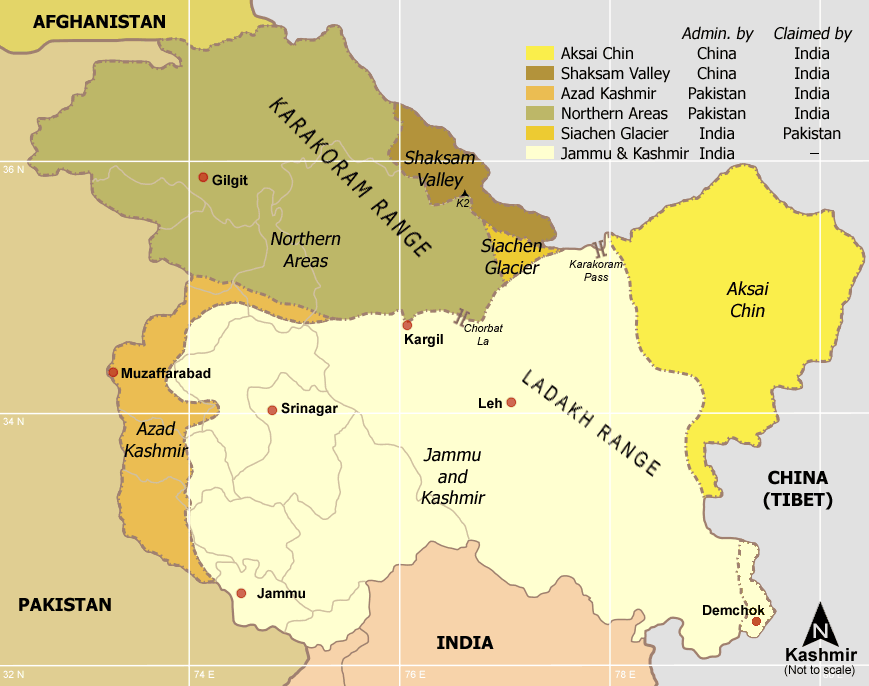
On Thursday, September 23 at a Congressional briefing of the House Select Committee on Energy Independence and Global Warming, about 'Extreme Weather in a Warming World' the Pakistani Ambassador to the US, Husain Haqqani, blamed the extensive floods in Pakistan partly on military activity on the Siachen Glacier on the disputed border between Indian and Pakistan in Kashmir. He said that "Human Activity in the glaciers" is partly to blame for climate changes that brought on the devastating floods in Pakistan this summer. He noted that the Siachen glacier, in particular, is host to a heavy presence of both the Pakistani and Indian militaries, although he noted that Pakistan has proposed to demilitarize the area. The Times of India called this 'an unusual remark'.
 The Siachen Glacier is the world's largest non-polar glacier. It is 43 miles long, and covers about 270 square miles (including its tributaries). Its heights are occupied by India, but it is claimed by Pakistan to be in their area of Kashmir.
The Siachen glacier has been at the heart of the long-running Kashmir border conflict between these two rivals. There was an excellent story from four years ago in Time Magazine, "War at the Top of the World" that detailed the conflict.
There is no question that the glacier is heavily militarized. It is home to the world's highest helipad, and both sides have brought troops. I confess that I haven't seen any scientific studies linking local human activity to changes on the glaciers. However, it would be logical that any local soot (black carbon) emissions could cause significant local melting. As I mentioned in my post about cookstoves, black carbon can cause melting on glaciers because its dark color warms the glacier in the sun, increasing its melting.
This is certainly an area that merits further study, and if these environmental concerns can help bring about a demilitarization of the volatile border, then some good could come out of this. On the other hand, I do wonder whether this was simply another example of a Pakistani officials going out of their way to antagonize India over Kashmir, as they have been threatening war over water.
 The Siachen Glacier is the world's largest non-polar glacier. It is 43 miles long, and covers about 270 square miles (including its tributaries). Its heights are occupied by India, but it is claimed by Pakistan to be in their area of Kashmir.
 The Siachen glacier has been at the heart of the long-running Kashmir border conflict between these two rivals. There was an excellent story from four years ago in Time Magazine, "War at the Top of the World" that detailed the conflict.
 |
| NASA's Satellite View of the Siachen Glacier |
This is certainly an area that merits further study, and if these environmental concerns can help bring about a demilitarization of the volatile border, then some good could come out of this. On the other hand, I do wonder whether this was simply another example of a Pakistani officials going out of their way to antagonize India over Kashmir, as they have been threatening war over water.
Friday, September 24, 2010
Climate Change and the Millennium Development Goals
This week, the UN General Assembly is meeting in New York. One of the key topics of discussion this week is a 10 year report on the progress towards the Millennium Development Goals. IISS intern Nathaniel Markowitz has written a guest post on how climate change is affecting the progress towards the MDGs.

Here is a full update on how well the world is meeting the MDG targets.

On Wednesday, September 22, the Millennium Development Goals Summit concluded in New York. With its conclusion, the General Assembly adopted a resolution titled Keeping the Promise: United to Achieve the Millennium Development Goals. This document stresses that addressing climate change is a lynch-pin for “safeguarding and advancing” progress toward achieving the MDGs. It notes that climate change has resulted in “increased vulnerabilities and inequalities and adversely affected development gains, in particular in developing countries.”
While addressing climate change is important for realizing all of the MDG, the resolution observes that it is particularly significant for eradicating extreme hunger and poverty (Goal 1) and ensuring environmental sustainability (Goal 7). Several passages underscore the dramatic and immediate impact climate change has on food security. The document also highlights the threat climate change poses to preserving biodiversity and fragile ecosystems.
The United Nations Framework Convention on Climate Change (the precursor of the Kyoto Protocol) is invoked as the primary forum for negotiating a global solution. Specifically, it reaffirms the principle of “common but differentiated responsibilities,” which recognizes that a country’s ability to mitigate its contribution to climate change is constrained by its capacities. [I don’t think I’ve ever seen a UN pronouncement that doesn’t include this phrase! - AH]
In addition to the outcome document, climate change was also addressed Tuesday at the roundtable on emerging issues. The discussion emphasized that “climate change will particularly impact land productivity and water availability, undermining rural livelihoods, with a disproportionate impact on women and vulnerable populations.” The panel recommends increasing investment in both renewable energy and developing resilience to climate impacts; encouraging implementation of a green economic growth strategy; and enhancing global and regional integration.
Tuesday, September 21, 2010
Global Alliance for Clean Cookstoves
Today in New York, Secretary Hillary Clinton announced the Global Alliance for Clean Cookstoves at the Clinton Global Initiative, hosted by her husband Bill Clinton. As well as the launch being an interesting bit of Clinton family cross branding, it could be an important new initiative that could improve the health of many poor people in the developing world - and help to reduce the threats of climate change in South Asia. As well as providing $50 million in US Government money for the project, the project boast support from across the public and private sectors.
Cookstoves are the target for this project because of their danger and their ubiquity. The alliance estimates that 3 billion people rely on traditional cookstoves and open fires for their daily cooking. These cookstoves are harmful to the health of the people doing the cooking, because of the 'black carbon' that they emit. Black carbon can be defined as fuel that has not been completely combusted. It is a common byproduct from burning wood, as well as dirtier fuels like kerosene or low-quality diesel. You can literally see black carbon: it is the black smoke that comes out of dirty stoves or dirty vehicles. The project aims to replace dirty stoves with clean efficient cookstoves (like the one pictured below) in 100 million households by 2020.
Reducing black carbon is essential for human health. Then that black smoke gets in your lungs it can cause asthma, lung damage, and premature death. The Alliance says that it causes 1.9 million deaths annually, and women and young children are often the most affected.
Reducing black carbon is also a key tool for mitigating climate change. Though black carbon does not contribute to the traditional greenhouse effect - unlike Carbon Dioxide it does not go in the upper atmosphere -- it is extremely important for local and regional warming. Essentially, the black color of the soot can increase the heat level. When it lands on snow or ice, the darker color will absorb more heat and reduce the amount of glaciers or snowpack. This is very important in the Himalayas, because one of the biggest areas of cookstove usage is in the Indian Subcontinent. More detail can be found in this testimony to Congress by VS Ramanathan, a leading scholar on its effects.
One of the great things about reducing black carbon is that it has immediate effects: when it rains, the carbon is literally washed out of the sky, so this program can have big effects on climate in the short term.
Take a look at their website here: http://cleancookstoves.org/. It looks like it just went live today.
 |
| A Cookstove in Mali |
Reducing black carbon is essential for human health. Then that black smoke gets in your lungs it can cause asthma, lung damage, and premature death. The Alliance says that it causes 1.9 million deaths annually, and women and young children are often the most affected.
 |
| Clean-burning Stove |
Reducing black carbon is also a key tool for mitigating climate change. Though black carbon does not contribute to the traditional greenhouse effect - unlike Carbon Dioxide it does not go in the upper atmosphere -- it is extremely important for local and regional warming. Essentially, the black color of the soot can increase the heat level. When it lands on snow or ice, the darker color will absorb more heat and reduce the amount of glaciers or snowpack. This is very important in the Himalayas, because one of the biggest areas of cookstove usage is in the Indian Subcontinent. More detail can be found in this testimony to Congress by VS Ramanathan, a leading scholar on its effects.
One of the great things about reducing black carbon is that it has immediate effects: when it rains, the carbon is literally washed out of the sky, so this program can have big effects on climate in the short term.
Take a look at their website here: http://cleancookstoves.org/. It looks like it just went live today.
Thursday, August 5, 2010
Climate, Weather and the Media
There is an excellent blog post on the Economist's 'Democracy in America' blog about the media's handling of two weather events of the last year: the snowstorms and the Russian fires. He presents an analogy of coverage of weather as part of climate change to coverage of the WWII on the Eastern Front: a small German victory in 1943 shouldn't have been mistaken as anything other than the exception to the rule of "the Red Army advancing implacably across western Russia in 1943-44."
I've written two posts in the last two days about Russia's heat, so I don't have much more to say on that. In the western media, M.S. is right that there has been vanishingly little efforts to link the fires and drought to climate change, but the Russian media has not had such a problem: in fact, one commentator went so far as to blame the drought on the US military's 'climate change weapons'. I should also note that other countries similarly have no problem calling a single event evidence of climate change: Pakistan's Environment Minister recently said that global climate change is to blame for this year's flooding and heavy rains. Likewise, Nigeria's Environment Minister said “The effects of climate change have been wide spread in Nigeria."
Perhaps it is because of the tradition of presenting both sides in a news article that our media is reluctant to cover it in this way - but I think that is a false balance. As M.S. said, if something is part of a larger trend (as these droughts are) then it should be presented in that way.
In addition, there are new studies showing that abnormally cold weather in the northern hemisphere (as we had last winter) may actually be a factor of an abnormally warm arctic. If that turns out to be the case, last winter wasn't actually an exception, it was just another example of the trend: global warming is happening at an accelerated rate, and we should not expect the weather of the future to be analogous to the weather of the past.
I've written two posts in the last two days about Russia's heat, so I don't have much more to say on that. In the western media, M.S. is right that there has been vanishingly little efforts to link the fires and drought to climate change, but the Russian media has not had such a problem: in fact, one commentator went so far as to blame the drought on the US military's 'climate change weapons'. I should also note that other countries similarly have no problem calling a single event evidence of climate change: Pakistan's Environment Minister recently said that global climate change is to blame for this year's flooding and heavy rains. Likewise, Nigeria's Environment Minister said “The effects of climate change have been wide spread in Nigeria."
Perhaps it is because of the tradition of presenting both sides in a news article that our media is reluctant to cover it in this way - but I think that is a false balance. As M.S. said, if something is part of a larger trend (as these droughts are) then it should be presented in that way.
In addition, there are new studies showing that abnormally cold weather in the northern hemisphere (as we had last winter) may actually be a factor of an abnormally warm arctic. If that turns out to be the case, last winter wasn't actually an exception, it was just another example of the trend: global warming is happening at an accelerated rate, and we should not expect the weather of the future to be analogous to the weather of the past.
Wednesday, August 4, 2010
DNI Nominee Clapper on Climate and Energy Security

In the section on national security threats, Clapper was asked to "discuss your view of the appropriate IC [Intelligence Community] roles and responsibilities with respect to the issues of climate change and energy security, and how well the IC has performed in these areas"
I will quote in full the answer he gave in writing to that question.
Global climate change could have wide-ranging implications for US national security interests over the next 20 years because it would aggravate existing world problems—such as poverty, social tensions, environmental degradation, ineffectual leadership and weak political institutions—that threaten state stability. Since the 2008 publication of the National Intelligence Assessment (NIA) on the national security implications of climate change, the IC has stepped up analysis and collection to look more in depth at climate change implications in individual countries and regions important to U.S. long term interests. The CIA has also created a center to provide all-source analysis on the impact of climate change on political, economic, military and social stability. It is also responsible for the MEDEA program which reviews and declassifies imagery for sharing with the climate scientific community.
Energy security has also been an important topic for Intelligence Community analysis and collection. To meet demand growth in next three to 10 years and reduce the risk of future price spikes, international and national oil companies will need to re-engage on major projects that were shelved when prices fell in late 2008. Within OPEC, Iraq is a bright spot for oil capacity expansion. Recent developments in the U.S. gas sector, primarily shale gas, have made the U.S. essentially gas independent for at least a decade or two, if not longer. The IC has for some time closely followed energy security developments, warning of longer term trends and highlighting potential opportunities for mitigating negative implications for U.S. national security.After the hearing, General Clapper had more to say in his response to post-hearing questions, saying that "the CIA could serve as the DNI's Executive Agent on Climate Change." To me, it is unclear if this means that the re-organization of the intelligence community's response to climate change, which I wrote about in May, will mean that all climate issues will be concentrated at the CIA's "Center for Climate Change and National Security". It would be a shame if it meant that they closed the National Intelligence Council's office of Climate Change and State Stability, which has done some excellent work.
Tuesday, August 3, 2010
The Real "Climate Change Weapon"
Following up on yesterday's post, which showed satellite pictures of the heat, drought and fires in Russia, I see that a widely-published Russian author, Andrei Areshev, deputy director of the Strategic Culture Foundation, alleges that has Russia's recent hot weather should be blamed on a US military program.
Here is his original article, "Climate Weapons. More Than Just a Conspiracy Theory?", and here is the Radio Free Europe/Radio Liberty article: "Russian Scholar Warns Of 'Secret' U.S. Climate Change Weapon."
This is a laughable conspiracy theory, and should be dismissed out of hand. In a conference which we held in early 2009, a questioner (who also seemed to be of the conspiracy-theory set) asked whether climate change could be used as a weapon. Our panel, consisting of speakers from the military, diplomatic, and intelligence professions, concluded that it would be very unlikely that climate change or carbon emissions could be used as a weapon. However, they did say that geoengineering does raise some particularly difficult geopolitical problems. Others have raised similar concerns about manipulating the climate and weather, through man-made geoengineering.

Though we can dismiss Areshev's argument out of hand, we should not underestimate the power of the argument underneath it. Areshev is wrong that the US Military is intentionally manipulating the climate by using the High-Frequency Active Auroral Research Program (HAARP) or some sort of space-based laser weaponry (which he claims is deployed on the X-37B, pictured at left). However, as the recent report from NOAA stated, it is 'undeniable' that the planet is warming, and that the decade 2000-2009 was the hottest globally on record. And, as the IPCC's 4th assessment report stated, "Most of the observed increase in global average temperatures since the mid-20th century is very likely due to the observed increase in anthropogenic GHG concentrations." The largest historical emissions of greenhouse gases come from the United States , and the US is currently the second largest current emitter (recently overtaken by China
As I wrote yesterday, you can never say that any one event is caused by global warming -- we have always seen drought and extreme weather -- but you should expect more extreme weather events like this. If, for the sake of argument, we say that this drought is caused by man-made global warming, then we can say that the US Russia , China , Brazil , India , Europe , and others. All industrial and industrializing countries share the responsibility for deploying this 'climate weapon' over the last century.
As the effects of climate change become more apparent, I believe that we will see more cases of blaming the US (or China) for climate change, even if it is simply added to a long list of grievances agricultural protectionism, globalization, colonialism, and others. Earlier this year, we saw Osama bin Laden accuse the US US US
Monday, August 2, 2010
Russia's Heat, Drought, and Fires - As Seen from Space
As the old saying goes, a picture is worth 1,000 words, and in this case a sequence of pictures shows exactly what's happened this summer in south western Russia, around the Volga River, in the region immediately north of the Caspian Sea. NASA's Earth Observatory satellites do an excellent job of showing views of major events as they happen.
First, at left we see a global map that shows temperature anomalies for July 4-11, as compared with the same dates from 2000 to 2008. These are the dates of the heat wave here on the US East Coast. Note the extreme dark red in South Western Russia, stretching from approximately the Ukraine border through Russia' Volga region, and in to Kazakhstan. The extreme red indicates temperatures of 12 degrees C (about 21 degrees F) above the average from last decade. Indeed, on July 11, Russia's hottest temperature in history was recorded in Yashkul, at 44.0°C (111.2°F).
 Second, at right, we see a satellite vegetation index image, that shows the damage done to plants and agriculture around the Volga river (pictured running through the center). For location reference, Ukraine is in the bottom left portion of the map, with Kazakhstan in the bottom right. In no area of this map is there any green, which would indicate above average vegitation. The darkest red areas show a reduction by over half. Note that this region is one of the main breadbaskets of Russia, and in some areas over 50% of the crop has already been lost. Potential losses from this area have driven wheat futures past $7 a bushel today, taking this grain's prices 67% above June's nine-month low.
 Finally, at left, we see the satellite photo of the predictable consequences of heat and drought: fire. The Volga River is labelled, and we see a haze of smoke extending across the entire region, completely covering Nizhiniy Novgorod. Fires across Russia have killed at least 40 people so far this summer. Today, President Medvedev declared a state of emergence in 7 regions across Russia, including Mari El, Ryazan, Mordovia, Vladimir, and Nizhny Novgorod (which are in this picture).
The US National Intelligence Council, in its report on the national security implications of climate change in Russia, says that Russia's agriculture will become "more vulnerable to droughts and other extreme weather" over the next decades as global warming takes hold. To add the usual caveat, you can never say that any one event is caused by global warming -- we have always seen drought and extreme weather -- but you can say this event is an example of what we should expect global warming to do.
 |
| Land Surface Temperature Anomaly, July 4-11 2010 |


The US National Intelligence Council, in its report on the national security implications of climate change in Russia, says that Russia's agriculture will become "more vulnerable to droughts and other extreme weather" over the next decades as global warming takes hold. To add the usual caveat, you can never say that any one event is caused by global warming -- we have always seen drought and extreme weather -- but you can say this event is an example of what we should expect global warming to do.
Subscribe to:
Posts (Atom)