Showing posts with label India. Show all posts

Monday, September 27, 2010

Floods Amplified by Military Activity in the Siachen Glacier?

On Thursday, September 23 at a Congressional briefing of the House Select Committee on Energy Independence and Global Warming, about 'Extreme Weather in a Warming World' the Pakistani Ambassador to the US, Husain Haqqani, blamed the extensive floods in Pakistan partly on military activity on the Siachen Glacier on the disputed border between Indian and Pakistan in Kashmir.  He said that "Human Activity in the glaciers" is partly to blame for climate changes that brought on the devastating floods in Pakistan this summer.  He noted that the Siachen glacier, in particular, is host to a heavy presence of both the Pakistani and Indian militaries, although he noted that Pakistan has proposed to demilitarize the area.  The Times of India called this 'an unusual remark'.

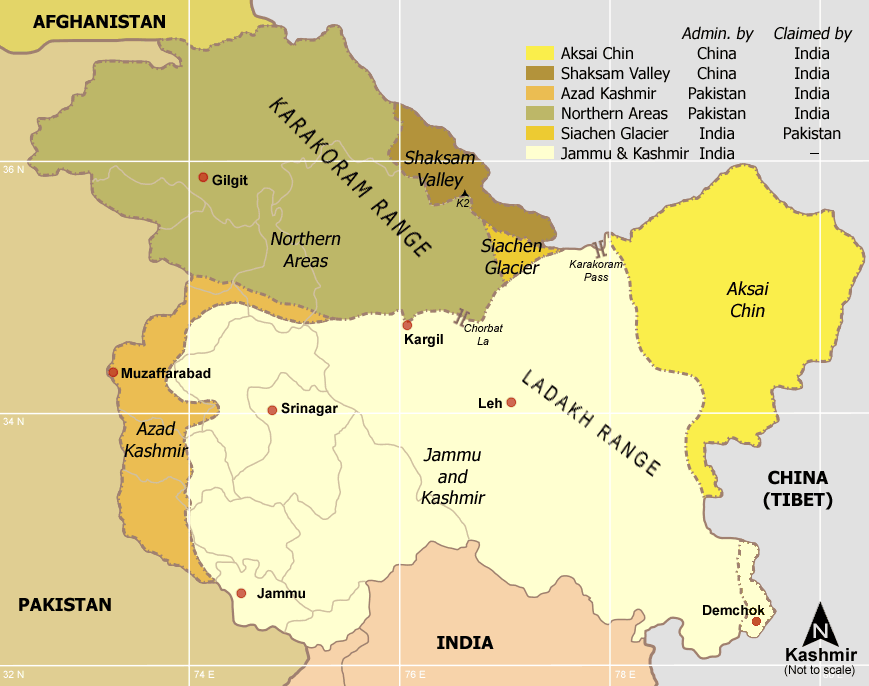
The Siachen Glacier is the world's largest non-polar glacier.  It is 43 miles long, and covers about 270 square miles (including its tributaries).  Its heights are occupied by India, but it is claimed by Pakistan to be in their area of Kashmir.

The Siachen glacier has been at the heart of the long-running Kashmir border conflict between these two rivals.  There was an excellent story from four years ago in Time Magazine, "War at the Top of the World" that detailed the conflict.

NASA's Satellite View of the Siachen Glacier
There is no question that the glacier is heavily militarized.  It is home to the world's highest helipad, and both sides have brought troops.  I confess that I haven't seen any scientific studies linking local human activity to changes on the glaciers.  However, it would be logical that any local soot (black carbon) emissions could cause significant local melting.  As I mentioned in my post about cookstoves, black carbon can cause melting on glaciers because its dark color warms the glacier in the sun, increasing its melting.

This is certainly an area that merits further study, and if these environmental concerns can help bring about a demilitarization of the volatile border, then some good could come out of this.  On the other hand, I do wonder whether this was simply another example of a Pakistani officials going out of their way to antagonize India over Kashmir, as they have been threatening war over water.

Tuesday, September 21, 2010

Global Alliance for Clean Cookstoves

Today in New York, Secretary Hillary Clinton announced the Global Alliance for Clean Cookstoves at the Clinton Global Initiative, hosted by her husband Bill Clinton.  As well as the launch being an interesting bit of Clinton family cross branding, it could be an important new initiative that could improve the health of many poor people in the developing world - and help to reduce the threats of climate change in South Asia.  As well as providing $50 million in US Government money for the project, the project boast support from across the public and private sectors.

A Cookstove in Mali
Cookstoves are the target for this project because of their danger and their ubiquity.  The alliance estimates that 3 billion people rely on traditional cookstoves and open fires for their daily cooking.  These cookstoves are harmful to the health of the people doing the cooking, because of the 'black carbon' that they emit.  Black carbon can be defined as  fuel that has not been completely combusted.  It is a common byproduct from burning wood, as well as dirtier fuels like kerosene or low-quality diesel.  You can literally see black carbon: it is the black smoke that comes out of dirty stoves or dirty vehicles.  The project aims to replace dirty stoves with clean efficient cookstoves (like the one pictured below) in 100 million households by 2020.

Reducing black carbon is essential for human health.  Then that black smoke gets in your lungs it can cause asthma, lung damage, and premature death.  The Alliance says that it causes 1.9 million deaths annually, and women and young children are often the most affected.  
Clean-burning Stove

Reducing black carbon is also a key tool for mitigating climate change.  Though black carbon does not contribute to the traditional greenhouse effect - unlike Carbon Dioxide it does not go in the upper atmosphere -- it is extremely important for local and regional warming.  Essentially, the black color of the soot can increase the heat level.  When it lands on snow or ice, the darker color will absorb more heat and reduce the amount of glaciers or snowpack.  This is very important in the Himalayas, because one of the biggest areas of cookstove usage is in the Indian Subcontinent.  More detail can be found in this testimony to Congress by VS Ramanathan, a leading scholar on its effects.

One of the great things about reducing black carbon is that it has immediate effects: when it rains, the carbon is literally washed out of the sky, so this program can have big effects on climate in the short term.

Take a look at their website here: http://cleancookstoves.org/.  It looks like it just went live today.
Tuesday, August 11, 2009

Signs of International Cooperation

Large emitters are showing greater international cooperation on climate change. The US, Mexico and Canada announced three ways to cooperate on climate change. Yesterday's Shanghai Daily ran an article headlined, ' China,U.S. must "seize the day" in climate change battle' calling for technology transfers and joint r&d funding. India and China now plan to not just study the Himalayan glaciers but to work on solutions. The Business Standard reports:
While the Indian scientists will study the glaciers on the Indian part of the Himalayas, their Chinese counterparts will undertake a similar exercise. Following this, both sides will exchange their findings and try to chalk out a comprehensive solution.
Does this 'comprehensive solution' mean there could an international agreement between China, an upstream country, and India, a downstream country to regulate water flow from the melting Himalayan glaciers? India is strategically vulnerable to China and would benefit from a legal agreement with China on water flow originating from the Himalayas.

Monday, August 3, 2009

The Strategic Importance of Water: India-China

India and China have begun discussions to jointly monitor the Himalayan glaciers that supply water to both the Ganges, Indus and Yangtze rivers. This is a promising sign of cooperation and mutual recognition of the importance of water in a region of the world with heightened risk of climate induced conflict. This will be one of the topics bound to come up at the conference in Nepal in a mouth on climate change. On August 28 China and India are both emerging powers who have fought over border disputes, and China, a key ally of Pakistan, supplies Pakistan with advanced military equipment and weaponry.

The terms of proposed cooperation between the two countries extend only to scientific monitoring of glacial melting in the Himalayas. Hopefully, this can broaden into a more comprehensive dialogue between the two countries over water management instead of mere monitoring because many of India's major rivers originate from the Tibetan plateau controlled by China. Brahma Chellaney, one of India's leading strategic thinkers on arms control and climate security, believes:
...China is now pursuing major inter-basin and inter-river water transfer projects on the Tibetan plateau, which threatens to diminish international-river flows into India and other co-riparian states. Before such hydro-engineering projects sow the seeds of water conflict, China ought to build institutionalized, cooperative river-basin arrangements with downstream states.
India's government recognizes its strategic situation and Indian minister Jairam Ramesh's recent trip to Beijing reflects that. Ramesh called China a "countervailing power" in efforts to resist pressure from Western nations for hard emission caps in this December's Copenhagen negotiations. Ramesh also said "India considers China to be its most important ally in the Copenhagen negotiation process." By stressing commonalities between India and China have on climate and trade, India can begin to engage China on a broader set of environmental issues, such as water management because climate change could lead to drought in India.

India and China face enormous population pressures and the demand for water in both countries will grow for the foreseeable future as each develops especially since India's population growth rate is higher than China's. Climate change is altering the balance of power between the two countries by increasing the importance of water, a variable that China controls.

Monday, March 2, 2009

Water Scarcity in South Asia

This weekend's USA Today had an article about how climate change could affect the monsoon season in South Asia. It is based on a study, using predictive computer models, about the strength and timing of how the monsoon season will change on the Indian Subcontinent.

Tree important results to note from this article: (1) the monsoon season is likely to arrive later; (2) the effects of the monsoon are expected to move further east, towards Bangladesh and Burma; and (3) the rains fo the monsoon season are likely to be less intense.

The effects of the monsoon season on India, Pakistan, Bangladesh, Burma, and Nepal should not be underestimated. Often called an 'economic lifeline' for India, the strength of the monsoon is crucial to India's agriculture, which supports about 60 percent of the nation's 1.1 billion population. The monsoon season, which lasts from approximately June through September, can provide 80% of India's annual rainfall. In years when it is stronger or earlier than usual, widespread flooding can occur, but when it is late or light, it can cause widespread crop failure.

The strength of the monsoon also has a strong effect on Himalayan glaciers, particularly in the southeastern Himalayas, around Everest and Nepal. I attended an event last week at the Stimson Center that showed strong evidence that these glaciers are already under pressure from climate change. With reduced rainfall from the monsoon, they will be under even greater pressure.

Because of the geopolitical and economic significance of South Asia, it will be important for more thorough studies to be done on the effects of climate change in this region.