Showing posts with label Himalayas. Show all posts

Wednesday, December 8, 2010

The Melt - Asia Society

The Asia Society's "China Green" project has a new video out on their website called "The Melt" that gives a very quick, but important overview on how the glaciers in the Himalayas are changing, and the impacts that are being felt by the people who live in that area.

The video is clearly of very high production quality, and relies not only on interviews of western researchers, as sometimes happen in these sort of productions, but they also sent a film crew to Tibet to chronicle the changes in glaciers.

Source: Asia Society
I've written about this on our blog several times.  Its important to remember that, although the IPCC report was wrong to say that all the glaciers may be gone by 2035, they are melting - at an increasing pace.

Some quick quotes from the video: "It's mostly about water"  "If this keeps going, people and animals will no longer be able to get enough water".  The focus on water as the first, and most important impact of climate change on human society tracks exactly with the findings of the IISS.

Videos and projects like this are extremely important, because they are not only aimed at western audiences.  By traveling over to China and interviewing people in Tibet, videos like this can raise awareness within China too about the impacts of climate change. As the two largest emitters of carbon, the US and China are the key players in acting to reduce their emissions - and nations act only when it is in their interest to act.  This video makes it clear that China, and Tibet, are already paying the costs for climate change.

I tried to have the video embedded here, but they have not released the code.  Head over to their website, and  watch the whole 10 minute video.  It is well worth your time.

Monday, September 27, 2010

Floods Amplified by Military Activity in the Siachen Glacier?

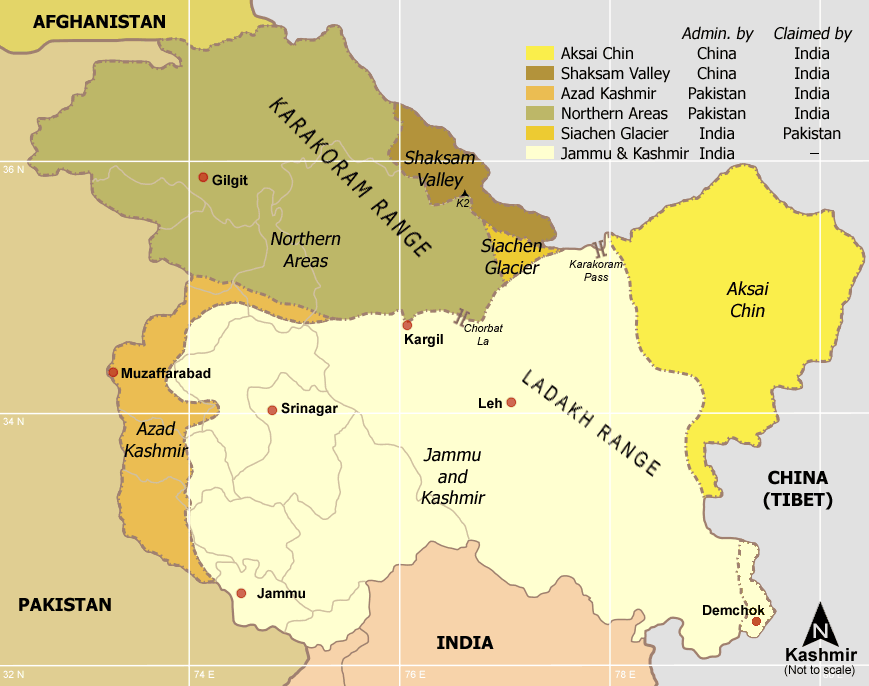
On Thursday, September 23 at a Congressional briefing of the House Select Committee on Energy Independence and Global Warming, about 'Extreme Weather in a Warming World' the Pakistani Ambassador to the US, Husain Haqqani, blamed the extensive floods in Pakistan partly on military activity on the Siachen Glacier on the disputed border between Indian and Pakistan in Kashmir.  He said that "Human Activity in the glaciers" is partly to blame for climate changes that brought on the devastating floods in Pakistan this summer.  He noted that the Siachen glacier, in particular, is host to a heavy presence of both the Pakistani and Indian militaries, although he noted that Pakistan has proposed to demilitarize the area.  The Times of India called this 'an unusual remark'.

The Siachen Glacier is the world's largest non-polar glacier.  It is 43 miles long, and covers about 270 square miles (including its tributaries).  Its heights are occupied by India, but it is claimed by Pakistan to be in their area of Kashmir.

The Siachen glacier has been at the heart of the long-running Kashmir border conflict between these two rivals.  There was an excellent story from four years ago in Time Magazine, "War at the Top of the World" that detailed the conflict.

NASA's Satellite View of the Siachen Glacier
There is no question that the glacier is heavily militarized.  It is home to the world's highest helipad, and both sides have brought troops.  I confess that I haven't seen any scientific studies linking local human activity to changes on the glaciers.  However, it would be logical that any local soot (black carbon) emissions could cause significant local melting.  As I mentioned in my post about cookstoves, black carbon can cause melting on glaciers because its dark color warms the glacier in the sun, increasing its melting.

This is certainly an area that merits further study, and if these environmental concerns can help bring about a demilitarization of the volatile border, then some good could come out of this.  On the other hand, I do wonder whether this was simply another example of a Pakistani officials going out of their way to antagonize India over Kashmir, as they have been threatening war over water.

Tuesday, September 21, 2010

Global Alliance for Clean Cookstoves

Today in New York, Secretary Hillary Clinton announced the Global Alliance for Clean Cookstoves at the Clinton Global Initiative, hosted by her husband Bill Clinton.  As well as the launch being an interesting bit of Clinton family cross branding, it could be an important new initiative that could improve the health of many poor people in the developing world - and help to reduce the threats of climate change in South Asia.  As well as providing $50 million in US Government money for the project, the project boast support from across the public and private sectors.

A Cookstove in Mali
Cookstoves are the target for this project because of their danger and their ubiquity.  The alliance estimates that 3 billion people rely on traditional cookstoves and open fires for their daily cooking.  These cookstoves are harmful to the health of the people doing the cooking, because of the 'black carbon' that they emit.  Black carbon can be defined as  fuel that has not been completely combusted.  It is a common byproduct from burning wood, as well as dirtier fuels like kerosene or low-quality diesel.  You can literally see black carbon: it is the black smoke that comes out of dirty stoves or dirty vehicles.  The project aims to replace dirty stoves with clean efficient cookstoves (like the one pictured below) in 100 million households by 2020.

Reducing black carbon is essential for human health.  Then that black smoke gets in your lungs it can cause asthma, lung damage, and premature death.  The Alliance says that it causes 1.9 million deaths annually, and women and young children are often the most affected.  
Clean-burning Stove

Reducing black carbon is also a key tool for mitigating climate change.  Though black carbon does not contribute to the traditional greenhouse effect - unlike Carbon Dioxide it does not go in the upper atmosphere -- it is extremely important for local and regional warming.  Essentially, the black color of the soot can increase the heat level.  When it lands on snow or ice, the darker color will absorb more heat and reduce the amount of glaciers or snowpack.  This is very important in the Himalayas, because one of the biggest areas of cookstove usage is in the Indian Subcontinent.  More detail can be found in this testimony to Congress by VS Ramanathan, a leading scholar on its effects.

One of the great things about reducing black carbon is that it has immediate effects: when it rains, the carbon is literally washed out of the sky, so this program can have big effects on climate in the short term.

Take a look at their website here: http://cleancookstoves.org/.  It looks like it just went live today.
Tuesday, January 19, 2010

The Glaciers of the Himalayas are still melting -- we just don't know how fast

Today, we've seen several articles saying that "World Misled over Himalayan Glacier Meltdown".  From my first reading of these articles, it appears that the IPCC relied on sketchy sourcing and little evidence for its claim in the 2007 IPCC report that the Himalaya's could be entirely ice-free by 2035. 

The rivers that begin with meltwater from the Himalayas are the source of fresh water for around 2 billion people in Asia.  These rivers are important for transportation, farming, fishing, tourism, and religious worship.  Because they cross heavily militarized borders, my blog and others writing about climate change and security have cited this area as a potential source of conflict.

It is important that everything we do in climate policy be grounded in sound science.  However, it is also important that security planners look beyond the lowest-common-denominator science, as its practiced by the IPCC.  We need to look at worst-case scenarios: if you plan for the worst, you'll be prepared for any eventuality. 

In fact, as I've written previously, the melting of the glaciers isn't even the most important part of the story.  Instead, a reduced snow melt, brought on by a reduced Indian Monsoon, is the biggest danger.  While glacier melt at a somewhat predictible (slow) rate, annual snowmelt is the largest driver of seasonal flooding.  The size of this snowmelt is the largest driver of this flooding, and that is predominantly driven by annual precipitation.  We simply do not know how climate change will affect the monsoon. 

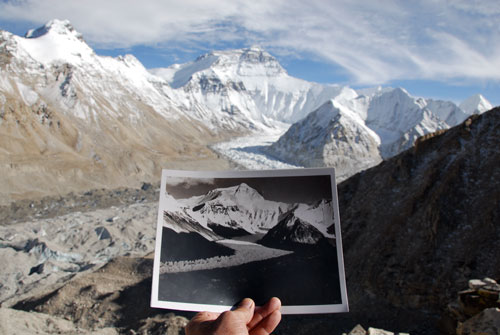
Similarly, this row with the IPCC shows that we simply don't know how climate change will affect the Himalayan glaciers.  We know that many have retreated significantly.  For instance, the famous Khumbu glacier, from which climbers begin their ascent of Mt. Everest, has retreated by over one kilometer in the last 50 years.  In fact, according to the blog From a Glaciers Perspective "Everest Base Camp has actually dropped from 5,320m to 5,280m since Hillary and Tenzing first set up camp for their ascent there more than fifty years ago."  The Guardian had an excellent series of photos earlier this year, showing before and after pictures of retreating glaciers.  (I've used one of their photos above) Photos don't lie: some glaciers, at least, are melting!

The answer here, is that we need better science about how glaciers are acting and will act.  We also need better science about how climate changes will affect precipitation in the region.  What we don't need are the typical voices saying that this small (but significant) problem with the IPCC supposedly invalidates all other pronouncements from them.

Tuesday, October 20, 2009

China and the Brahmaputra


As a follow-up to the previous post on the need for cooperation among the nations dependant on the rivers from the Himalayas, I've come across a report, "Dammed Rivers" from The Economist's Asia columnist, Banyan saying that Gezhouba, a Chinese construction company, had begun work on a dam across the Yarlung Tsangpo in Tibet, near the India-China border. When it enters India, this river is known as the Brahmaputra, emptying through Bangladesh into the Bay of Bengal.

Related, there is a story in yesterday's Times of India about Indian concerns over the beginning of a plan to divert water from the Yangtze River at the border of the Hubei and Henan provinces in Central China. The Yangtze is a river entirely within the borders of China, so at first glance it would appear that India should not be worried. However, an elaborate network of canals, resevoirs, and dams could concievably connect the rivers to the Yarlunch Tsangpo before it crosses into India. This would divert India and Bangladesh's water north to China.

Earlier this year, I had asked a geologist who specializes on the glaciers of Himilayas whether China could dam or divert the headwaters of any of their major rivers that begin in Tibet, like the Brahmaputra, the Ganges, or the Mekong. He said that such an engineering project would be impossible, because the area is so geologically active and the threat of earthquakes is too great. However, the Chinese are faced with a long-term, dire drought in the North, and they may think that massive engineering projects could get them out of that.

Certainly, diverting the flow of the Yarlung Tsangpo would provoke anger downstream in both India and Bangladesh. The question remains, though, to what extent would they go to stop it? Could conflict ensue over dwindling water resources?

Reports about the Himalayas

The Financial Times reports today from Kathmandu about the dwindling amount of snow and ice on the glaciers of the Himalayas. Sometimes called 'the Third Pole', these mountains are the sourse for at least 10 of Asia's major rivers. Changes in the flow of these rivers caused by glacier and snow melt could affect the livliehoods of around 2 billion people.

This article makes the claim that what's important is not actually the retreat of the glaciers, but the decline in the snowpack. Melting snow, they claim, is what feeds the seasonal rivers.  This is the first time that I've seen that enunciated. With credit to the FT, I reproduce their chart showing the rapid loss in water (snow, ice, or rain) from the Himilayas since 1960. What is most striking about this graph is that this decline has been constant since 1960, and the 1998-2008 decade -- the warmest in the human record -- is not even acounted for on this graph. We desperately need more and better information about what is happening in this region.

With better information, government ministers can determine how best to divide the dwindling water resources coming from the Himalayas. In September, environment ministers from across East and South Asia met in Nepal in the first example of intergovernmental meetings to discuss this topic.