
India and China have begun discussions to
jointly monitor the Himalayan glaciers that supply water to both the Ganges, Indus and Yangtze rivers. This is a promising sign of cooperation and mutual recognition of the importance of water in a region of the world
with heightened risk of climate induced conflict. This will be one of the topics bound to come up at
the conference in Nepal in a mouth on climate change. On August 28 China and India are both emerging powers who have fought over border disputes, and China, a key ally of Pakistan, supplies Pakistan with
advanced military equipment and weaponry.
The terms of proposed cooperation between the two countries extend only to scientific monitoring of glacial melting in the Himalayas. Hopefully, this can broaden into a more comprehensive dialogue between the two countries over water management instead of mere monitoring because many of India's major rivers originate from the Tibetan plateau controlled by China.
Brahma Chellaney, one of India's leading strategic thinkers on arms control and climate security, believes:
...China is now pursuing major inter-basin and inter-river water transfer projects on the Tibetan plateau, which threatens to diminish international-river flows into India and other co-riparian states. Before such hydro-engineering projects sow the seeds of water conflict, China ought to build institutionalized, cooperative river-basin arrangements with downstream states.
India's government recognizes its strategic situation and Indian minister Jairam Ramesh's recent trip to Beijing reflects that. Ramesh called China a "countervailing power" in efforts to resist pressure from Western nations for hard emission caps in this
December's Copenhagen negotiations. Ramesh also said "India considers China to be its
most important ally in the Copenhagen negotiation process." By stressing
commonalities between India and China have on climate and trade, India can begin to engage China on a broader set of environmental issues, such as water management because climate change could
lead to drought in India.
India and China face enormous population pressures and the demand for water in both countries will grow for the foreseeable future as each develops especially since
India's population growth rate is higher than
China's. Climate change is altering the balance of power between the two countries by increasing the importance of water, a variable that China controls.
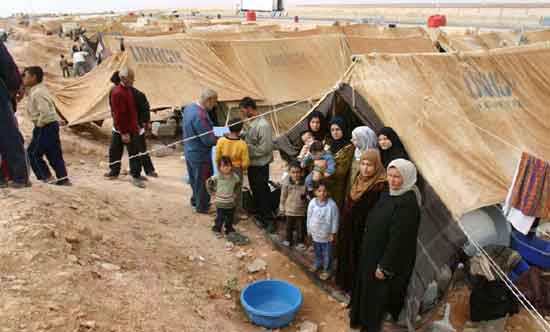 s sovereignty because they undermine the control states have over their borders. Territorial integrity is one of the hallmarks of a sovereign nation. For Australia, controlling its borders are easier. It's an island; refugees from neighboring states such as Kiribati would have to arrive by boat with plenty of warning. However, in the Middle East, refugees created by environmental devastation could create security problems. The recently released Arab Development Report 2009 states:


