Friday, October 15, 2010

Water Wars - or Water Riots?

Today is 'Blog Action Day 2010', and this year, bloggers around the world are writing about water.  To join in, I've put together a post on how water insecurity had led to conflict around the world.  I've also added their 'widget' to the bottom of the page for this weekend only - why not sign the petition?


Oropoi, Kenya - Photo courtesy IRIN
In the security sector, water security is sexy as an issue because of the perceived threats of interstate conflict over shared water supplies, like rivers or lakes. Journalists love writing stories about 'water wars'.  We've written about this on this blog before, like when we discussed the Strategic Importance of Water between India and China or whether India and Pakistan can share the Indus.  Unfortunately for the hype of the journalists, projects like Aaron Wolf's Transboundary Freshwater Dispute Database at the University of Oregon or Peter Gleick's Pacific Institute have shown that shared water supplies have been much more likely to help promote interstate cooperation than to provoke conflict.  In fact, in our work on climate change and security at the IISS we have found widespread agreement among experts that the more pressing threat when we discuss water and conflict is its potential to create or exacerbate local civil and ethnic conflicts.  


When looking at the causes of any conflict analytically, it is difficult to separate the effects of water shortages from other factors, like food shortages, migration, ethnicity, climate change or other issues that could drive violence. However, the impact of water over energy, development, agriculture, and livelihood makes it one of the most important factors. When water insecurity is mixed with urbanization, migration, pollution, radicalization, and a proliferation of small arms, it is not difficult to see a scenario resulting in conflict.


Water shortages or imbalances of water distribution can be driver of civil conflict in a marginalized society. In terms of terminology, ʹwater riotʹ is more appropriate that ʹwater warʹ. Examples of small‐level riots - some leading to deaths - can be shown in Nigeria, South Africa, Yemen, Egypt, India, and Ecuador. These water riots can be expected to show similar characteristics to the food‐related riots that erupted around the world in 2008. Areas of particular risk are those with strong ethnic or tribal divisions, and the effects of water riots may be to drive disaffected and marginalized parts of society away from areas of water stress.


While no one factor (like water, ethnicity, or unemployment) was able to correctly predict when these regions fell into conflict, changes in water security often can be enough to tip a region over the edge.

Monday, September 27, 2010

Floods Amplified by Military Activity in the Siachen Glacier?

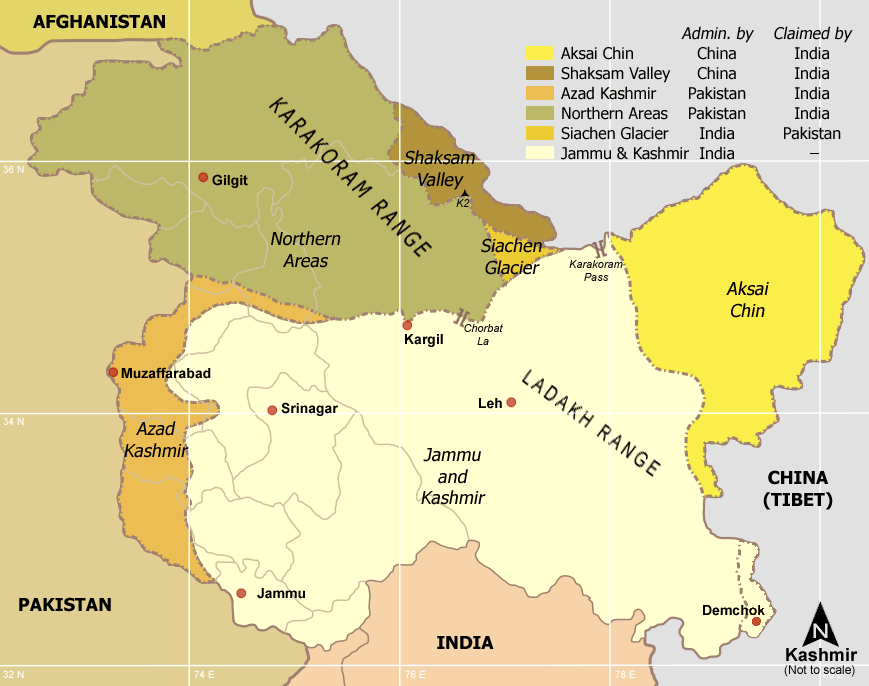
On Thursday, September 23 at a Congressional briefing of the House Select Committee on Energy Independence and Global Warming, about 'Extreme Weather in a Warming World' the Pakistani Ambassador to the US, Husain Haqqani, blamed the extensive floods in Pakistan partly on military activity on the Siachen Glacier on the disputed border between Indian and Pakistan in Kashmir.  He said that "Human Activity in the glaciers" is partly to blame for climate changes that brought on the devastating floods in Pakistan this summer.  He noted that the Siachen glacier, in particular, is host to a heavy presence of both the Pakistani and Indian militaries, although he noted that Pakistan has proposed to demilitarize the area.  The Times of India called this 'an unusual remark'.

The Siachen Glacier is the world's largest non-polar glacier.  It is 43 miles long, and covers about 270 square miles (including its tributaries).  Its heights are occupied by India, but it is claimed by Pakistan to be in their area of Kashmir.

The Siachen glacier has been at the heart of the long-running Kashmir border conflict between these two rivals.  There was an excellent story from four years ago in Time Magazine, "War at the Top of the World" that detailed the conflict.

NASA's Satellite View of the Siachen Glacier
There is no question that the glacier is heavily militarized.  It is home to the world's highest helipad, and both sides have brought troops.  I confess that I haven't seen any scientific studies linking local human activity to changes on the glaciers.  However, it would be logical that any local soot (black carbon) emissions could cause significant local melting.  As I mentioned in my post about cookstoves, black carbon can cause melting on glaciers because its dark color warms the glacier in the sun, increasing its melting.

This is certainly an area that merits further study, and if these environmental concerns can help bring about a demilitarization of the volatile border, then some good could come out of this.  On the other hand, I do wonder whether this was simply another example of a Pakistani officials going out of their way to antagonize India over Kashmir, as they have been threatening war over water.

Friday, September 24, 2010

Climate Change and the Millennium Development Goals

This week, the UN General Assembly is meeting in New York.  One of the key topics of discussion this week is a 10 year  report on the progress towards the Millennium Development Goals. IISS intern Nathaniel Markowitz has written a guest post on how climate change is affecting the progress towards the MDGs.  

On Wednesday, September 22, the Millennium Development Goals Summit concluded in New York.  With its conclusion, the General Assembly adopted a resolution titled Keeping the Promise: United to Achieve the Millennium Development Goals. This document stresses that addressing climate change is a lynch-pin for “safeguarding and advancing” progress toward achieving the MDGs.  It notes that climate change has resulted in “increased vulnerabilities and inequalities and adversely affected development gains, in particular in developing countries.” 

While addressing climate change is important for realizing all of the MDG, the resolution observes that it is particularly significant for eradicating extreme hunger and poverty (Goal 1) and ensuring environmental sustainability (Goal 7).  Several passages underscore the dramatic and immediate impact climate change has on food security.  The document also highlights the threat climate change poses to preserving biodiversity and fragile ecosystems.

The United Nations Framework Convention on Climate Change (the precursor of the Kyoto Protocol) is invoked as the primary forum for negotiating a global solution.  Specifically, it reaffirms the principle of “common but differentiated responsibilities,” which recognizes that a country’s ability to mitigate its contribution to climate change is constrained by its capacities.  [I don’t think I’ve ever seen a UN pronouncement that doesn’t include this phrase! - AH]

In addition to the outcome document, climate change was also addressed Tuesday at the roundtable on emerging issues.  The discussion emphasized that “climate change will particularly impact land productivity and water availability, undermining rural livelihoods, with a disproportionate impact on women and vulnerable populations.”  The panel recommends increasing investment in both renewable energy and developing resilience to climate impacts; encouraging implementation of a green economic growth strategy; and enhancing global and regional integration.

Here is a full update on how well the world is meeting the MDG targets.